
categories: physics, automation & robotics, mechanics
Second bonus post. So far in this series "kinematics" meant plugging numbers into $$v=v_0+at$$. That only works when acceleration is constant. The moment acceleration depends on velocity itself — drag, thrust, anything realistic — you have to go back to the definition $$a=\frac{dv}{dt}$$ and actually solve a differential equation. Good news: for this classic case, the equation is simple enough to solve by hand with one technique, separation of variables, that you'll reuse constantly.
Worked example: motion with drag proportional to $$v^2$$
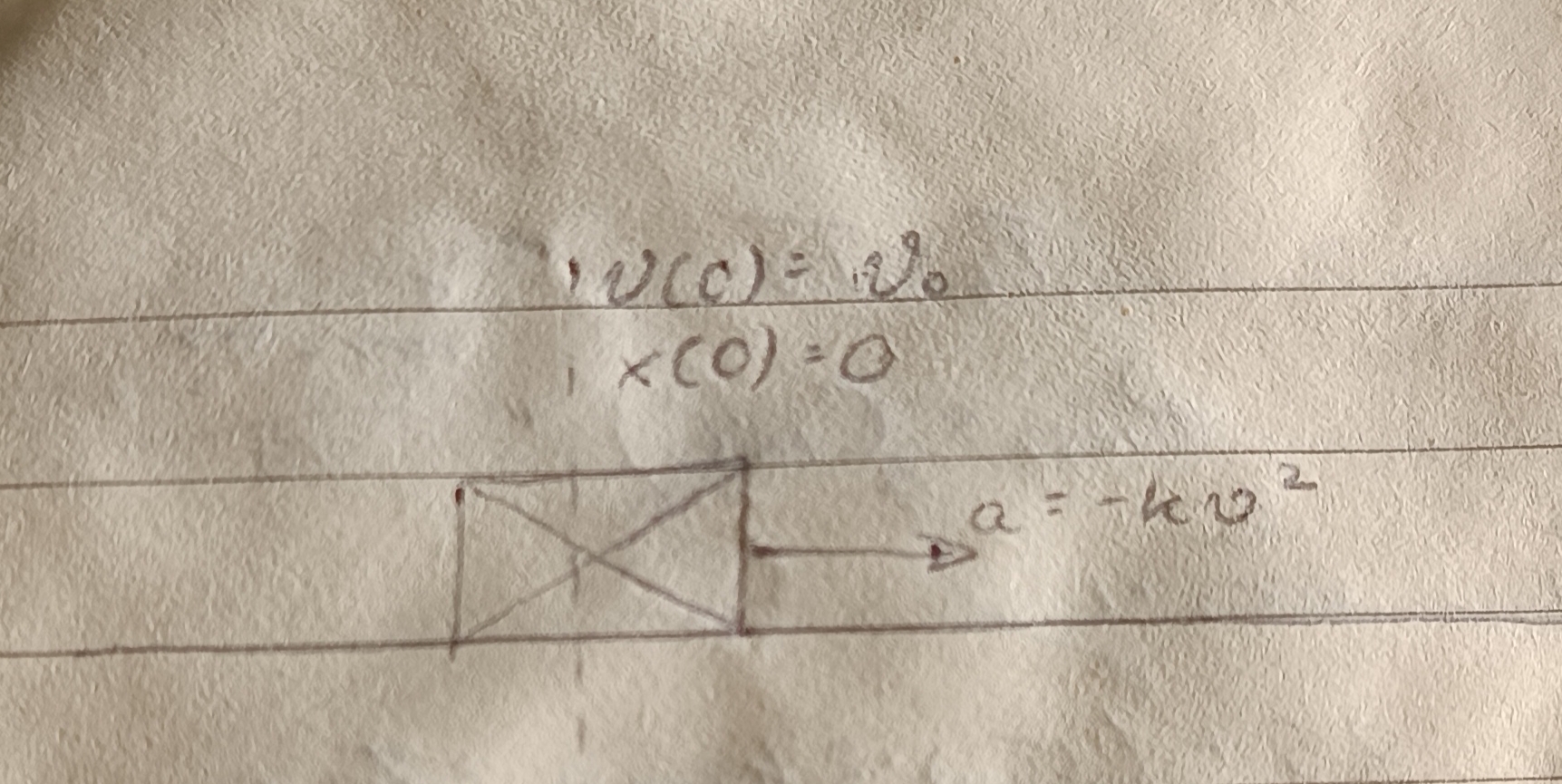
A body moves along a straight line through a resisting medium (think air or water drag at moderate-to-high speed, where resistance scales with the square of velocity, not velocity itself). Its acceleration is $$a(v)=-kv^2$$, with $$k>0$$ constant. At $$t=0$$: position $$x(0)=0$$, velocity $$v(0)=v_0$$. Find $$v(t)$$ and $$x(t)$$.
Step 1 — solve for v(t) by separating variables. Replace acceleration with $$\frac{dv}{dt}$$, then get every $$v$$ term on one side and every $$t$$ term on the other — that's the whole trick of "separation of variables": $$\frac{dv}{dt}=-kv^2 \implies \frac{dv}{v^2}=-k\,dt$$ Integrate both sides, left from $$v_0$$ to $$v(t)$$, right from $$0$$ to $$t$$: $$\int_{v_0}^{v(t)}\frac{dv}{v^2}=-k\int_0^t dt \implies \left[-\frac{1}{v}\right]_{v_0}^{v(t)}=-kt \implies -\frac{1}{v(t)}+\frac{1}{v_0}=-kt$$ Rearranging for $$v(t)$$: $$v(t)=\frac{v_0}{1+kv_0t}$$ Notice the shape: at $$t=0$$ you recover $$v_0$$ exactly, and as $$t\to\infty$$ the speed decays like $$1/t$$ rather than exponentially — quadratic drag "gives up" slowing you down much more gently at low speed than it did at high speed, since the braking force itself shrinks with $$v^2$$.
Step 2 — integrate velocity to get position. Same separation-of-variables move, one level up: $$v(t)=\frac{dx}{dt}$$, so $$dx=\frac{v_0}{1+kv_0t}\,dt \implies \int_0^{x(t)}dx=\int_0^t\frac{v_0}{1+kv_0t}\,dt$$ Substituting $$u=1+kv_0t$$ (so $$du=kv_0\,dt$$) turns the right-hand integral into a plain $$\int\frac{du}{u}$$, i.e. a logarithm: $$x(t)=\frac{1}{k}\ln(1+kv_0t)$$ This is the pattern worth remembering: whenever acceleration depends only on velocity, $$a(v)=dv/dt$$ turns into a separable ODE in $$v$$ and $$t$$; solve that first, then integrate the resulting $$v(t)$$ once more to get $$x(t)$$. Two integrations, never more, as long as you separate variables at each stage.
Same method every time: write $$a=dv/dt$$, separate $$v$$ and $$t$$, integrate once for $$v(t)$$, integrate again for $$x(t)$$ if you need it. Next post: the same technique applied to a problem where mass itself is changing over time. Thank you for reading! Next post: deriving the rocket equation the same way.
Read more