
categories: physics, automation & robotics, mechanics
Same trick as last post — separate variables, integrate — but this time applied to a body whose own mass is changing while it moves. That single difference is what turns ordinary $$F=ma$$ into the Tsiolkovsky rocket equation.
Worked example: the rocket equation with gravity
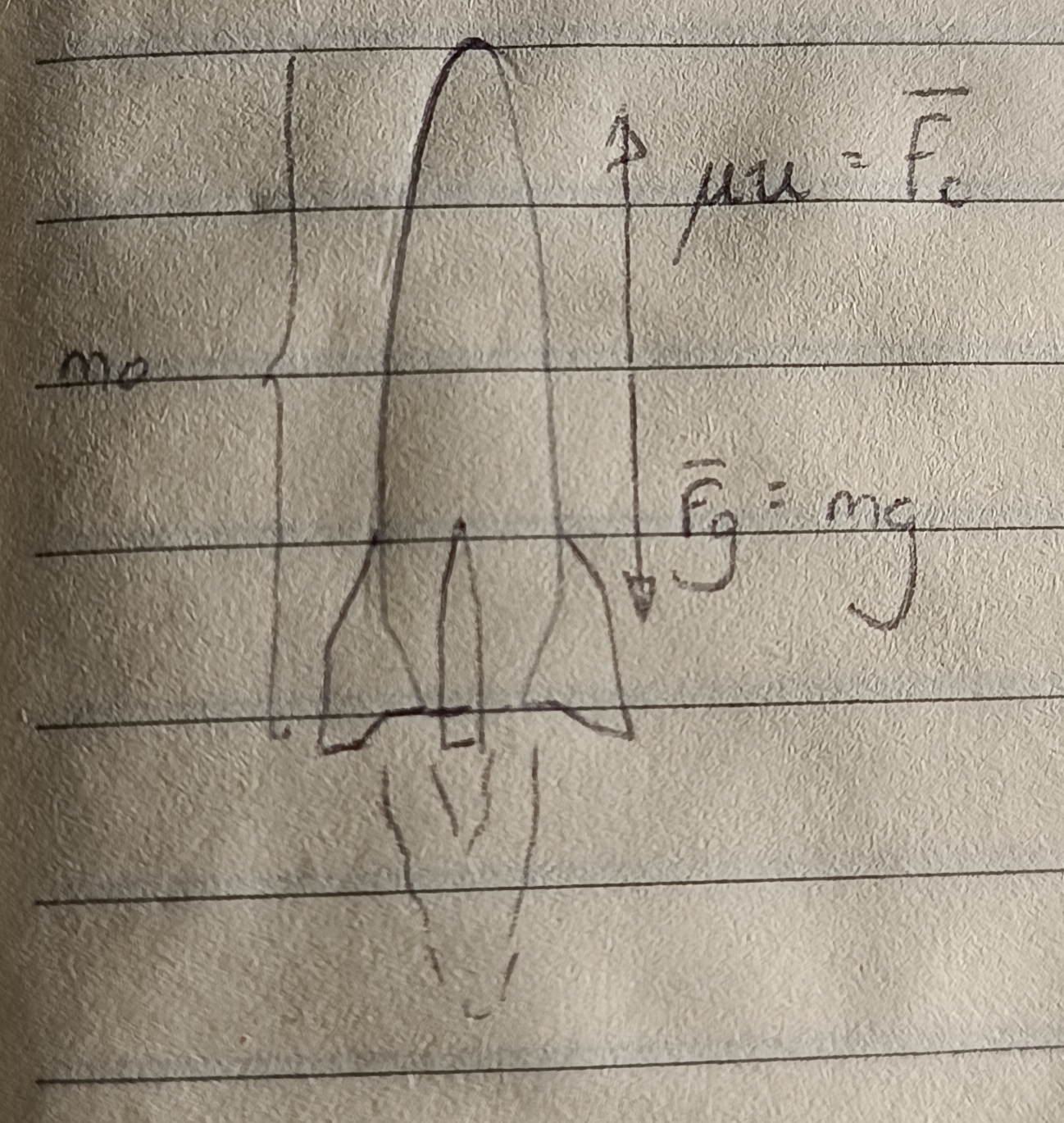
A rocket of initial mass $$m_0$$ launches vertically from the ground in a uniform gravitational field $$g$$. Exhaust gas leaves at constant speed $$u$$ relative to the rocket, and mass burns off at a constant rate $$\mu=-\frac{dm}{dt}$$. Find $$v(t)$$ and the burnout speed.
Step 1 — set up the variable-mass equation of motion. This is the Meshchersky equation: thrust from ejecting mass, minus weight, equals mass times acceleration, where the rocket's mass itself is shrinking over time, $$m(t)=m_0-\mu t$$: $$m(t)\frac{dv}{dt}=-m(t)g+u\mu$$
Step 2 — separate variables and integrate. Divide through by $$m(t)$$: $$dv=\left(-g+\frac{u\mu}{m_0-\mu t}\right)dt$$ Integrate both sides from $$t=0$$ (where $$v(0)=0$$) to $$t$$: $$v(t)=\int_0^t -g\,dt' + u\mu\int_0^t\frac{dt'}{m_0-\mu t'} = -gt + u\Big[-\ln(m_0-\mu t')\Big]_0^t = -gt+u\ln\!\left(\frac{m_0}{m_0-\mu t}\right)$$ Using $$m(t)=m_0-\mu t$$, this cleans up to the Tsiolkovsky rocket equation with a gravity-loss term tacked on: $$v(t)=u\ln\!\left(\frac{m_0}{m(t)}\right)-gt$$ The first term is the "ideal" rocket equation — pure momentum bookkeeping, no gravity — and it's the reason rockets are staged: the mass ratio $$m_0/m(t)$$ sits inside a logarithm, so you need it to grow exponentially just to gain velocity linearly, and most of a rocket's launch mass has to be propellant just to get a modest $$\Delta v$$. The $$-gt$$ term is pure cost: every second spent burning fuel while still fighting gravity is velocity you never get back, which is exactly why rocket engineers care so much about thrust-to-weight ratio, not just total propellant.
Step 3 — burnout velocity. Burnout happens once all propellant mass $$m_p$$ has been consumed, at time $$t_k=\frac{m_p}{\mu}$$, leaving a dry (structure-only) mass $$m_k=m_0-m_p$$. Substituting: $$v_{max}=u\ln\!\left(\frac{m_0}{m_k}\right)-g\frac{m_p}{\mu}$$
Same recipe as always: identify the forces (here, thrust from ejected mass plus weight), write $$F=m\,dv/dt$$, separate variables, integrate. The only new ingredient was letting $$m$$ itself be a function of $$t$$. Thank you for reading! Next post: switching gears to practical embedded-systems engineering — sizing a battery for a real onboard electronics setup.
Read more