
categories: mathematics
Hello everyone,
as I promised, so I deliver, admittedly with a slight delay, but always 🙂
So let this post be the opening, the beginning of my story about integral calculus.
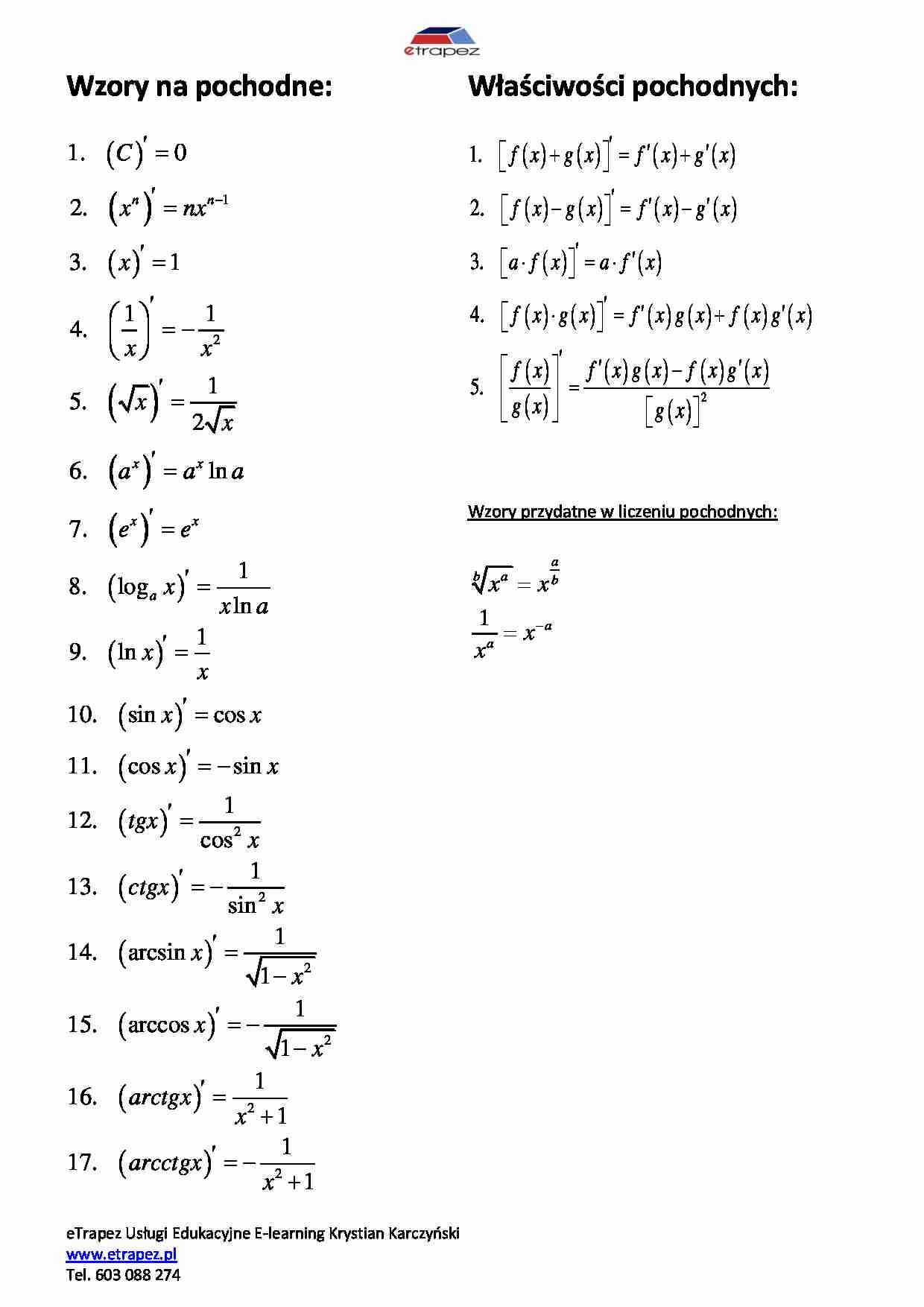
Let's start from the very beginning. What will you need? The ability to think logically + the formulas for derivatives of basic expressions (i.e. the derivative of a product, a quotient, etc...) I'll also include below a picture from a formula sheet, showing exactly what I mean 🙂. Remember: Accumulation of data -> Riemann Sums
Example:
Let's say you want to calculate how much water will be in a tank
that is being filled at a constant rate of 5 L/min for 6 minutes.
Of course, you don't need integrals to calculate something like this,
simple logic is enough: Volume = Time * Rate => 5 *
6 = 30.
Now take a sheet of paper and try to draw this situation graphically on a chart 🙂 If you put time on the horizontal axis, and the rate of change on the vertical axis, then the area you get up to x = 6 will represent both the volume and the definite integral from 0 to 6 of the rate-of-change function with respect to time. Don't worry if this sounds complicated right now, I assure you it isn't. I'll soon post a video from which you'll be able to learn more 🙂
Good, if you're curious, let's go further... If you now say to yourself on your chart: "I want to divide this area under the curve into a sum of the areas of certain rectangles with a base (the one on the time axis) equal to $$\Delta x = 1$$ (of course you can do that)" you'll get a definite integral expressed as a Riemann sum. This is not an approximation at all, because you determined the exact area (i.e. exactly how much water actually flowed in). Good, but let's say the rate of change is not linear. What now? At this level of understanding you can't yet calculate the definite integral directly, but you can use APPROXIMATION WITH RIEMANN SUMS. I already mentioned what this involves, but I'll explain it again. You take an interval (in our case on the time axis)
you set \(\Delta x\) on that interval (if the interval is 6 and you want 6 rectangles approximating this area, then $$\Delta x = \frac{6}{6} = 1)$$, so $$\Delta x = 1$$.
Depending on whether you want to calculate the right Riemann sum or the left one (I'll explain in a moment what that means), you pick the corresponding heights for \(\Delta x\), sum them up, and you have an approximation of how much water flowed in given a non-linear rate of change.
So what's the difference between the left and right Riemann sum? In value: minimal (but neither one (right vs left) is inherently "better"). In practice: significant, because when computing the left approximation you take the height at the left corner of the rectangle's side and calculate it as $$LeftRectangleHeight * \Delta x$$. Whereas for the right sum you calculate only $$RightRectangleHeight * \Delta x$$. I wouldn't be myself if I didn't mention the most difficult Riemann sum (requiring more calculations), which is without a doubt the midpoint Riemann sum. What does it involve? Well, $$\Delta x = const$$, just as you chose it, but as a rule you now take not the left or right height, but the height at the midpoint of our \(\Delta x\). For example, you have $$\Delta x = 2$$, so your height, assuming the rate of change is expressed by the function f(t), will be given as $$f(\frac{\Delta x}{2})$$ and this procedure, just like for the other rectangles, extends to all the rectangles that make up your area 🙂. And at the end you sum them all up 😉.
So you can see that what's hidden behind what we call RIEMANN SUMS is really nothing difficult. You've probably also noticed that I said little about the definition of the integral. A fair observation 🙂 I preferred to save that for the end, since this is only an introduction. We can define the definite integral as that RIEMANN SUM with the number of \(\Delta x\) tending to infinity. Since there will then be infinitely many \(\Delta x\), there will consequently also be more rectangles, which will give us the EXACT AREA of our region.
Thank you for reading! This article will appear on YouTube soon, so be sure to follow along!
Read more