
categories: mathematics
Hello everyone,
In today's article we'll learn the technique for calculating the indefinite integral of \(\frac{1}{x}\), sin(x), cos(x) (+ other functions) and \(e^x\). Let's dive in! I won't dwell too much this time on why the integral of a given function is defined the way it is, since you already know the method behind correct integration. The integral of a given function -> which function, after being differentiated, gives me the integrand? Let's get to it.
INTEGRALS OF TRIGONOMETRIC FUNCTIONS
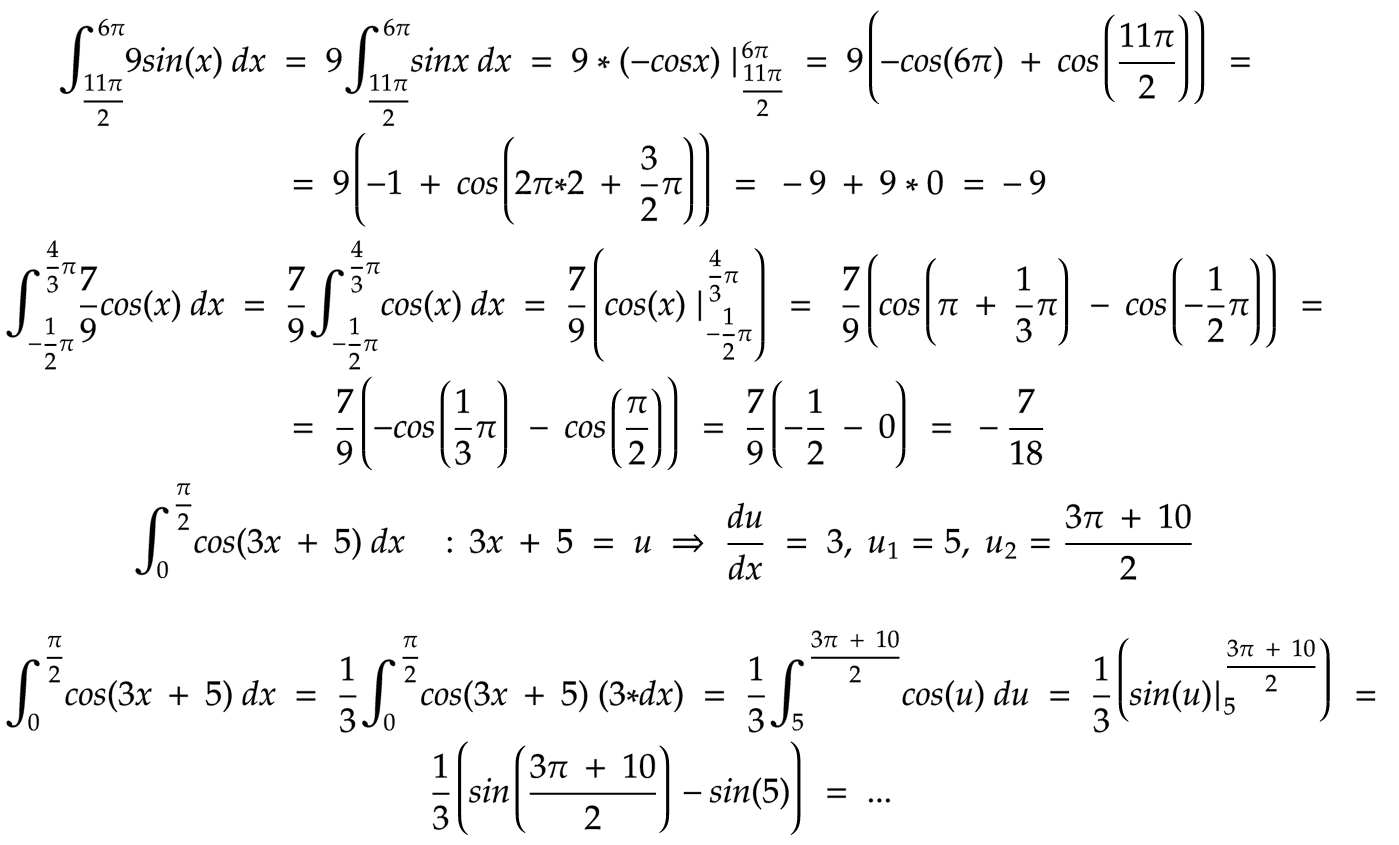
The indefinite integral of the function: $$\int sin(x) dx = -cos(x) + C$$, where C is an arbitrary numerical constant. The indefinite integral of: $$\int cos(x) dx = sin(x) + C$$. The indefinite integral of the function: $$\int sec^2(x) = tan(x) + C$$. The indefinite integral of: $$\int csc^2(x) = -cot(x) + C$$. The indefinite integral of: $$\int sec(x)tan(x) dx = sec(x) + C$$. The indefinite integral of the function: $$\int csc(x)cot(x) dx = -csc(x) + C$$ You'll find the examples above in the picture below this material 🙂
THE INDEFINITE INTEGRAL OF E TO THE X
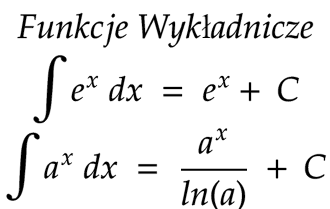
Now for a quick one. The indefinite integral of the function: $$\int e^x$$ is, of course, equal to $$e^x + C$$. But where does this formula come from? By now the thought has surely crossed your mind: "What are you even talking about?! You can just look it up in the formula sheet!" True enough! But I don't want you to just mindlessly memorize what I give you — I also want you to be able to picture it for yourself! What do you think the result will be of integrating an exponential function of the form a to the power x? Well, it's actually the quotient of the function a to the power x and the natural logarithm of a, i.e.: $$\int a^x dx = \frac{a^x}{ln(a)}$$. So we see that if a = e, then our denominator will give a result of 1, which will finally bring us to the result in the numerator of the form: \(e^x + C\). Don't worry if you didn't understand this. Try taking a blank sheet of paper and writing out what I just talked about 🙂 You'll definitely understand it then!
THE INTEGRAL OF 1 / X
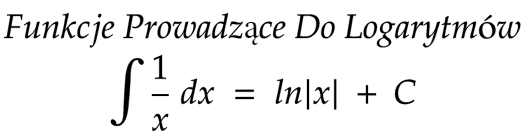
The last integral we'll cover today is the integral of the function \(\frac{1}{x}\). The result here is in fact ln|x| + C. The proof of this fact is a bit complicated and completely unnecessary at the level we're at. I'm just giving you what will make it easier for you to work with integrals!
BONUS
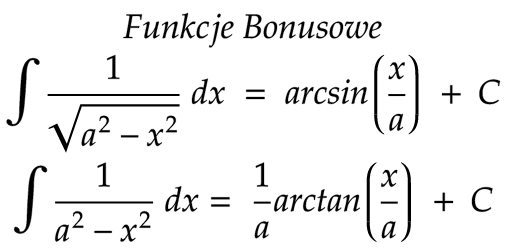
Now I'd also like to give you a little bonus! This isn't mandatory for you though, since we won't be doing any examples with it (given that it's simply very time-consuming). Nevertheless, I encourage you to work through a couple of examples that will come up in one of the upcoming materials (Of course it won't be like I'll just throw integrals at you and let you figure them out on your own! Of course not! That would be very unreasonable of me 🙂 Let's agree on this: I'll solve 3 examples for every topic I present (and it'll be the hardest one you'll encounter), and afterward you (only if you feel like it, no pressure) will solve 2 more examples to the best of your ability! Don't worry, they'll be really simple! But that's still about 2 articles away. I still have a few things left to show you!) So, the bonus:
$$\int \frac{1}{\sqrt{a^2 - x^2}} dx = arcsin(\frac{x}{a}) + C$$
$$\int \frac{1}{a^2 + x^2} dx = \frac{1}{a} * arctan(\frac{x}{a}) + C$$
As you can see, these aren't easy formulas, and I assure you -> they're not easy to use either, and they require practice! Thank you for reading!
Cheers 🙂
Read more