
categories: mathematics
Hello everyone,
We now actually have behind us most of the information needed to calculate any area under a curve defined by any formula on any interval. We've learned methods for approximating the area under a graph. We've also learned the definition of the definite integral and the fundamental theorem of calculus. Today I'll show you how easily you can calculate the area under the graph of any power function, of course using the concept of the integral.
CALCULATING THE INDEFINITE INTEGRAL OF A POWER FUNCTION
Let's say we have an indefinite integral of the function x to the power n, where n is not equal to -1. That is: $$\int x^n dx$$ Because the scheme I'll show you doesn't work for that power (-1). Back to it... To calculate such an integral, we should of course increase the exponent of x by 1, so we'll have: $$x^n+1$$. Then divide the whole thing by (n + 1). Now the question arises: why? Look closely (it would be best if you wrote this down). If you differentiate the function x to the power (n + 1) divided by (n + 1), the exponent moves in front of x and the exponent itself is reduced by one. Look: $$\frac{(n + 1)*x^{n+1-1}}{(n + 1)}$$ As a result, the (n + 1) in the numerator cancels with the (n + 1) in the denominator, and we're left with just the function: $$x^n$$, which is our original function that we integrated. So we see that this is exactly how we can calculate any integral of a power function.
PROPERTIES OF INTEGRALS
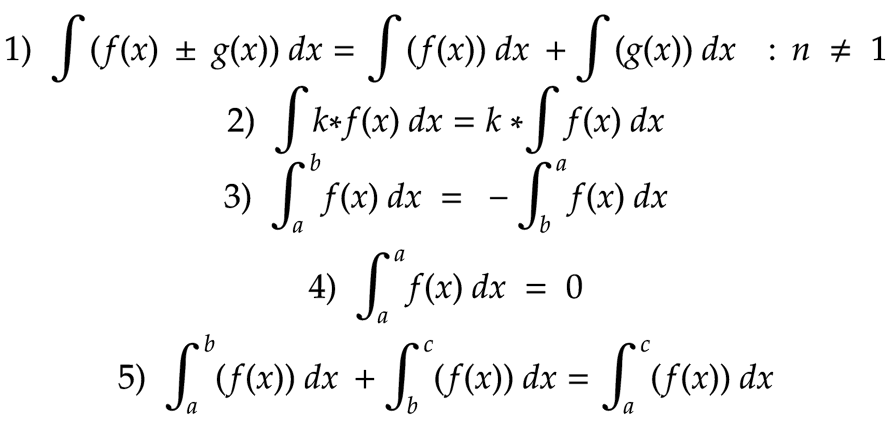
Now let's get familiar with the properties of integrals so that, with the knowledge we already have, we can calculate the integral of any polynomial of degree n other than -1. Let's say we have the indefinite integral of the sum of two functions: f(x) and g(x). Then the result will be the sum of the integral of f(x) and the integral of g(x). Don't worry if you didn't understand anything I just wrote. Below you'll find a picture illustrating all the most important properties of integrals (the ones we particularly need). Another property of integrals worth remembering is that if we have a certain constant under our integral (we can denote it as k), then we can pull that constant out in front of the integral (picture below the material). Another property is that we can freely swap the interval of integration (I mean that you can swap the lower and upper bounds), just remembering to add a minus sign to the resulting function. Furthermore... if you integrate over the interval from a to a, for a belonging to the set of real numbers, then the area given by such an integral will be 0. And finally, the "creme de la creme". Something that will let us calculate "seriously nasty stuff (I know what I'm saying)", namely definite integrals of trigonometric and inverse trigonometric functions over intervals (of course, at the end of the course I'll also give you a few examples with an integral over an interval of an ordinary polynomial). That's it, thanks for reading this article!
Cheers 🙂
Read more